
There’s a quiet enrollment killer hiding in plain sight in almost every graduate school.
It’s not your ad budget.
It’s not your CRM.
It’s not your rankings.
It’s your program pages.
Your website program pages are the doors prospective students use to enter your inquiry list.
We see them as the front door, but are you treating them like the basement window?
Your program pages are either helping you win visibility and trust or quietly sending students to your competitors. And here’s the hard truth: most schools haven’t caught up. They’re still optimizing for an internet that no longer exists.
Below are three warning signs that your program pages are costing you inquiries right now, and how to fix them.
Table of contents:
- You’re writing for you, not for search (or students)
- You’re ignoring search intent signals
- You’re still thinking like it’s 2019
- Why this matters now
1. You’re writing for you, not for search (or students)
A whole lot of program pages read like they were written to please internal stakeholders, not actual humans making a life-changing decision.
They’re filled with institutional jargon, vague claims of “academic excellence,” and paragraphs that bury the very things students want to know. They want outcomes, flexibility, cost, and what makes your program worth their time and money.
Here's how SEO for higher education used to work: in the old world, keyword stuffing and long-form content could still get you ranked. But in the world of AI-driven search, that’s not going to fly. (Read our blog about what in the world is going on with AI search).
Search models are learning to summarize, compare, and recommend. They’re pulling structured, student-centered information, not marketing fluff. AI platforms are actively ignoring your marketing jargon.
If your content isn’t written with that in mind, your visibility will fade, and your competitors who do understand this shift will own the top of the funnel.
The fix: Rewrite your program content around questions students actually ask.
“Is an MHA worth it?”
“How long does a counseling program take?”
“What jobs can I get with a data science degree?”
Those are the phrases AI tools are parsing and recommending from. If your page can’t answer those clearly and directly, you’re not the answer.

2. You’re ignoring search intent signals
Your program page might be attracting traffic, but if it’s not the right traffic, you’re paying for it in lost conversions.
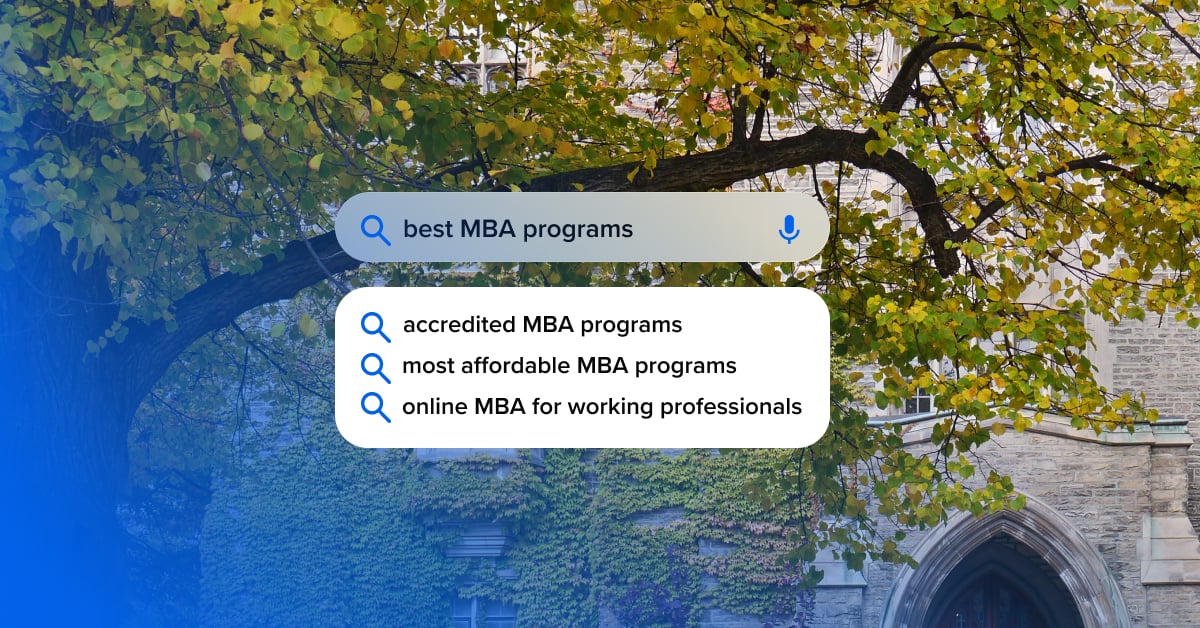
A student searching “MBA online no GMAT” has a completely different intent than someone searching “what can I do with an MBA?”
The first is ready to apply; the second is exploring options.
Many schools send both audiences to the same catch-all page with the same generic copy.
AI-driven search tools like ChatGPT are built to understand intent far better than we are. They reward clarity, context, and relevance. If your content doesn’t match that, you’re losing both visibility and inquiry potential to institutions that have mapped their content strategy to specific search journeys.
The fix: Create differentiated pages or content clusters based on intent: exploratory, comparative, and conversion-focused. Give each its own role in the student journey. Then, make sure each page has a clear call to action that matches where that user is mentally.
This is where AI optimization and human-centered content merge, and where the enrollment wins are happening right now.
3. You’re still thinking like it’s 2019
The biggest red flag? You haven’t revisited your program pages in a few years. Or worse, you only update them when leadership requests a new line about accreditation or faculty awards.
Meanwhile, your competition is quietly optimizing their pages monthly, running content experiments, and aligning with how Google’s AI overviews and other models summarize graduate programs.
In the next year, search and AI-generated results will increasingly decide for students which programs deserve attention. That means visibility will be about representation inside AI-driven recommendations and summaries. If your content doesn’t fit that model’s needs, you’ll be filtered out before a student even sees your name.
The fix: Treat your program pages like live digital assets, not static brochures. Audit them quarterly for search visibility, search intent alignment, and competitive positioning. What keywords are being lost? Which are gained? How are people finding the page?
Why this matters now
For most graduate schools, 2026 will be a make-or-break year. The domestic student pool is shrinking. Paid media costs are rising. And AI-driven search will increasingly favor a handful of well-optimized, high-authority institutions — not necessarily the ones with the biggest brands, but those that adapt the fastest.
If your program pages aren’t structured, written, and optimized for this new world, you’re not just missing out on clicks; you’re being quietly erased from the consideration set altogether.
So before you spend another dollar on digital ads or another month debating messaging, start where it matters most: your program pages. Because in this new search landscape, they’re not just pages. They’re your front door. Right now, too many of them are locked.
Here, take the keys: grab our SEO + AI Visibility playbook to get our cheat codes around search optimization. There are too many valuable, world-changing programs out there, sitting in the dark.
Take our playbook, optimize your pages, and send us a message if you have a question.





.png)