

Graduate schools are notoriously under-resourced compared to their undergraduate counterparts. That’s no secret to those in the industry — undergraduate enrollments are the predominant revenue source for most colleges and universities, enabling institutions to largely focus their time, effort, and resources on furthering the interests of those students. As a result, grad schools have often lived in Field of Dreams territory —“If you build it, they will come”— with relatively limited investments.
For institutions with a strong pedigree or those that benefit from broad awareness (e.g., flagship public institutions), that mentality has largely worked over time. As colleges and universities face societal and political headwinds, particularly those associated with the “enrollment cliff,” they’ve realized that placing more attention on non-traditional student audiences (such as graduate students) is critical to their viability. In layman’s terms, graduate schools are playing a larger role in the enrollment ecosystem than ever before.
Graduate enrollment professionals have long yearned for deeper institutional investment in their operations, but often struggle to make a compelling, data-informed case to move up the priority list. Enter Direct Development’s first-of-its-kind Marketing Cost Per Enrollment (MCPE) for Graduate Schools research initiative.

With widespread usage of higher ed CRMs and other related technology, enrollment marketers can easily track every click, every inquiry, and every application. And with sophisticated systems like HubSpot, they can even track bottom funnel enrollments to every related marketing activity throughout the student journey. But many cannot answer a simple question: “How much marketing spend does it take to enroll a graduate student?”
For too long, graduate programs have operated in the shadow of undergraduate-focused benchmarks or generic total “recruitment cost” metrics that bundle overhead expenses with actual marketing output. This lack of specificity makes it nearly impossible to defend or request a budget, pivot a strategy mid-cycle, or know if your spend is truly competitive.
This is precisely why DD launched a multi-year MCPE initiative for grad schools in 2024. We aren’t just looking for a number; we are pioneering a standard. As we move toward our full 2026 Research Report following the NAGAP GEM Summit, it’s time to move beyond generic budget asks and start empowering GEM professionals with data-informed benchmarks to level-set your marketing investments.
Key takeaways
- Even institutions with the most brand cachet have to start investing more in their graduate programs as competition for grad students intensifies.
- The Marketing Cost Per Enrollment (MCPE) figure provides graduate enrollment leaders with a measurement for the true cost of enrolling a student by isolating direct marketing investments.
- Benchmarking your MCPE against similar institutions can help justify budgets, identify funnel inefficiencies, and guide smarter marketing decisions.
- Context matters: institution type, program mix, modality, and market position all influence what a healthy MCPE should look like.
What is MCPE?
MCPE stands for Marketing Cost Per Enrollment. While it sounds straightforward, the nuance lies in its isolation. Unlike general marketing cost metrics that rely on aggregated budgets and overhead, MCPE focuses exclusively on the direct financial investments made to acquire, nurture, and enroll new graduate students.
The MCPE figure provides a means for enrollment professionals to reflect on the investments they’re making to enroll new students, but it more importantly provides a metric as a basis for comparison with other programs and institutions to assess appropriate resource allocation.
How is the MCPE for grad schools calculated?
To establish a true industry benchmark, we utilize a standardized methodology that accounts for the complexity of the graduate student marketing landscape. For our formal research report, we explore variables like institution type, size, and location, and their influence on MCPE.
The MCPE math itself is straightforward: divide total marketing expenses for a specific enrollment cycle by the number of newly enrolled students in that cycle.
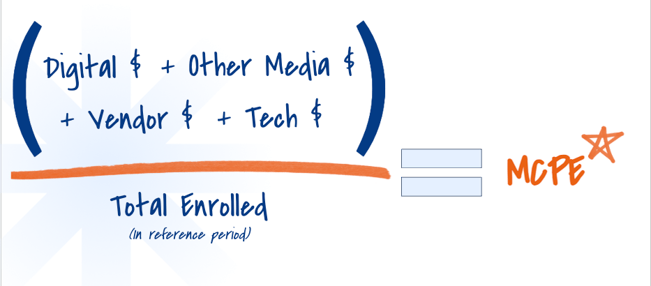
For the purpose of calculating your MCPE, we use the following four key inputs to comprise your total marketing expenses:
- Digital Advertising: Paid search & display ads, social media ads, and other related advertising through digital channels
- Non-Digital Advertising: Print, billboards, direct mail, list buys, graduate fairs, and other non-electronic advertising activities
- Technology Stacks: The portion of your CRM, automation tools, or analytics platforms dedicated to marketing (not including your student information system unless it is used to market to or recruit students)
- Vendor & Agency Fees: Expenses paid for any external vendor services or consultants used for marketing purposes
By isolating these variables, we move away from “noisy” data and get a clear view of the actual marketing price tag attached to each new graduate student.
Why is calculating your MCPE important?
Understanding your MCPE isn’t just an accounting exercise; it is a strategic necessity for three reasons:
1. Defending your budget with authority
When you can show that your MCPE is significantly below the industry average for your institution type, region, or discipline, you aren’t just asking for more money; you’re presenting an opportunity to scale an efficient machine. Conversely, if your MCPE is high, you have the data to argue for a shift in strategy, partner, or technology to improve conversions and build a more sustainable enrollment marketing plan.
2. Identifying “the efficiency gap”
High inquiry volume is a vanity metric if those inquiries aren’t converting. MCPE forces GEM professionals to look at the entire funnel. If your marketing spend is high but your enrollment is stagnant, your MCPE can highlight gaps in the middle and bottom portions of your funnel and provide opportunities to address follow-up engagement and yield activities.
3. Navigating the competitive landscape
The graduate market is more crowded than ever. Without a benchmark, you are flying blind. Knowing where you stand against your peers allows you to set realistic enrollment targets based on actual marketing costs rather than vanity metrics, last year’s goals, or even gut feelings.

Important considerations
It’s important to remember that MCPE is not one-size-fits-all. A specialized master’s program will naturally have a different revenue profile than a PhD program, and a high-pedigree urban institution will have to make different marketing investments than a small rural college.
This is why our research emphasizes contextual benchmarking. Factors like institution size, public vs. private status, and program modality all play a role. The math behind MCPE is not rocket science; any institution can sit down and calculate its MCPE. Alternatively, DD’s MCPE research is not designed to give you a single “magic number,” but to provide a living resource that compares your institution to others with similar profiles, ensuring the data is as fair as it is insightful.
If you’re ready to contribute to the industry’s most robust dataset on graduate MCPE, review the research and input your data into the MCPE Calculator and Benchmarking Tool. You’ll receive a personalized real-time dashboard to see exactly how your marketing efficiency stacks up against other graduate schools. (Note: your data is aggregated and anonymized — the insights, however, are yours to keep.)







.png)