

Key takeaways
- Identify who you actually want to target, not just those who follow you.
- Study your competitors for inspiration, and use their strategy's success as a benchmark for your own.
- Track meaningful metrics to understand the full picture of what works — and what doesn't — with your content.
- Treat social media strategy as a short, iterative process.
A new semester has begun, and you’re probably brainstorming your institution’s paid and organic social media marketing strategy for the fall. Higher ed marketers everywhere are doing the same, and likely facing the same challenges you might be. (And that's not even considering all the recent changes facing digital advertising for higher education!)
Let me guess – you're getting increased pressure from above because your leads have dipped, the marketing budget has changed, and you're staring at a blank spreadsheet not knowing what content is worth the effort. You might even be considering grabbing your Dean to recreate a viral video you saw on Reels for a few easy reposts.
It's a wild time to be in higher education. But your digital strategy doesn't have to be.
University marketing strategies can be complex and reactive at times, but all enrollment marketers really need is a clear roadmap with built-in flexibility. Every institution has its tried-and-true social media content, and that’s a great starting point, but here’s how you can develop a strategy that is flexible and actually converts social media engagement into enrollment results.
- Get to know your target audience.
- Take inventory of what content you already have.
- Make your KPIs your North Star.
- Keep the competition in your peripheral.
- Don't be afraid of bad content.
- Leave some wiggle room.

Step 1: Identify and segment your target audiences
When it comes to social media targeting, your audience is who you want, not who you already have. Sarah's mom may like all of your Facebook posts, but if you're counting on likes alone, you can also count on no real growth.
The Facebook Insights tool will give you a better understanding of the people who like your page, engage with your content, and provide a quick demographic overview. The chart below is a great example of a real graduate school's following broken out by gender and age ranges. As you can see, they have a pretty healthy following from men and women in the 25-34 and 35-44 age ranges — a tight match to many of their target personas.
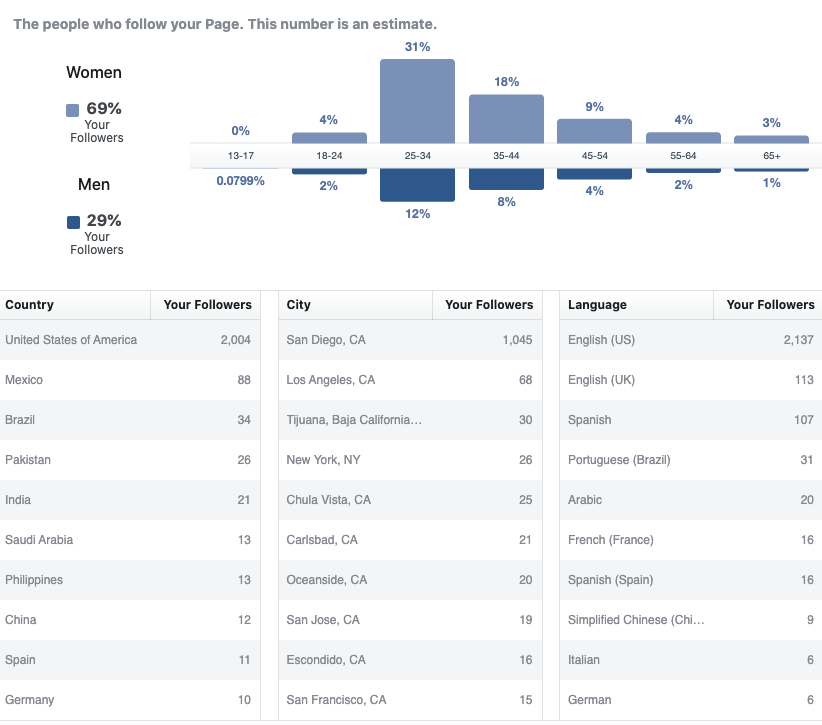
This insight will help inform your paid social media strategy, and you can optimize as you see fit. Your goal is to become keenly aware of their likes, dislikes, hopes, dreams, goals — you get the idea — and then mold your content to fit their needs.
For example, a recent business graduate is interested in your MSA degree, but has a few questions. How about throwing some information session schedules into your organic content calendar? Or publishing a carousel on how to become an accountant? Or interviewing a notable MSA alum for a blog post? The options are endless.
Your best bet:
Think about the students you want, create personas to determine what content they need, and cross-reference that with the Facebook Insights data.
Step 2: Take inventory and bucket your content to map out an effective social media strategy
For an effective social media strategy, you'll want to identify what content you have and don't have in your inventory.
Comb through the photo archives, pull all the video clips, and see what’s already been published that can be retired or recycled (no prospective student wants to see a grainy video of your institution from the 80s). Keep an open mind while doing this; lots of content can be uniquely repackaged for your target audience. Content variety is your biggest differentiator in digital strategy, and without it, prospective students might scroll by.
At this point in the process, you’ve assessed what you already have. If you feel inclined, create additional assets that are newer, trendier, or simply updated with the times to add to your collection. You don’t have to do this, nor do you need to hire a professional. Most higher ed budgets are tight, and eye-catching content can be captured just as well from your phone.
Now that you have everything compiled, bucket your assets into different campaigns. If you’re somewhat new to social media marketing, categorize your campaigns as follows: brand awareness, lead generation, and student engagement.
Each of these campaign types will have very different content messaging, but don’t necessarily need new content. The hard part is often creating the content needed to have that diversity we talked about, but usually, enrollment marketers are sitting on plenty of rich content that just exists in one form right now. For example, a video of your campus can be repurposed to fit into all three of these buckets simply by changing the copy associated with the video. Or a photo you take on campus could be the background of an infographic, a new webpage header, and a rainy-day content piece. The world is your oyster here.
Your best bet:
Create brand awareness, lead generation, and student engagement campaign buckets that run simultaneously, and alternate these posts to create a steady balance.
Step 3: Determine the key metrics for your higher education social media strategy
No one knows what university marketing strategies will work simply by following their gut. Key performance indicators, or KPIs, are a collection of data points that show areas of success within your campaigns or can be a great clue on where to optimize next. You’ll need to follow a few KPIs like the North Star to get the most out of your digital strategy.
The metrics that you choose to record will depend on the type of campaign you’re running, and what your current institutional priorities are. Here’s a quick breakdown you can use to get started:
- Brand Awareness: impressions, reach, shares, new followers
- Lead Generation: impressions, clicks, inquiries/contact submissions
- Student Engagement: likes, shares, reposts, and comments
There's about a million more KPIs where that came from here.
If you’re operating some or part of your university marketing strategies in-house, social media schedulers like Hootsuite and Buffer are budget-friendly options for institutions and offer a ton of insight on these metrics.
Your best bet:
Determine 3-5 key metrics to track that align with each campaign's goal.
Step 4: Understand and keep a close eye on your competition's digital strategy
The phrase “keep your friends close and your enemies closer” is a bit dramatic but immediately comes to mind here. Your marketing team knows your competitor institutions and the programs that are up against yours, but are you checking in on what they’re doing across all of their social media platforms? When developing your university marketing strategies or determining the types of content you want to publish, assess your competitors' top-performing posts and make them your own, while leaving everything else.
But how? Use the Facebook Insights tool in the Business Manager and monitor their pages to see what they’re publishing and how it all performs. Do this for 3-4 of your top competitors and you’ll have a small library of social post frameworks to work with.
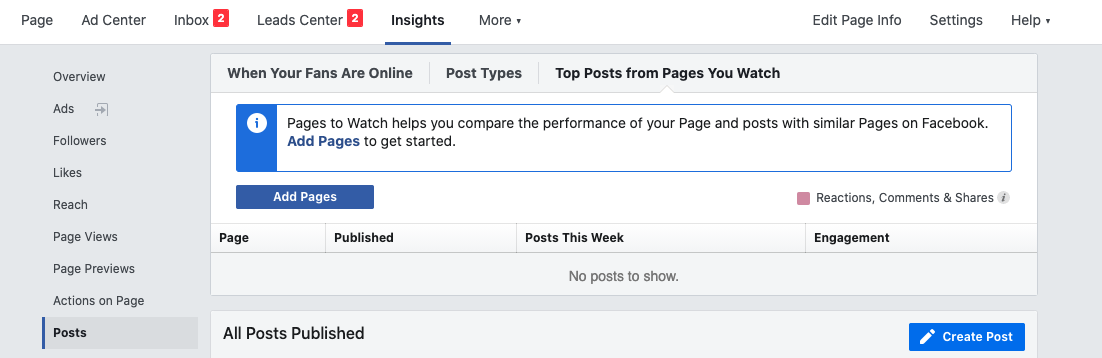
Similarly, the Google Ads Transparency Center does the same thing.
You’ll quickly notice the variety of content types you should be incorporating into your digital strategy: blog posts, user-generated content, videos, ebooks, downloadable resource guides, and messages aimed at brand awareness. Versatility is the name of the game when it comes to creating social media marketing for universities.
While keeping the competition in your peripheral vision, make sure you don’t lose sight of your own institution’s tone, style, or unique brand when developing your digital strategy. At the end of the day, your university’s marketing strategy should be immediately identifiable and authentically yours.
Your best bet:
Turn a competing institution's good ideas into great ones, rather than starting from scratch. Ensure that you make the copycat content unique enough to represent your institution well.
Step 5: Set ambitious goals (but don't be afraid of bad content)
As you schedule out new content for your paid and organic social media marketing campaigns, you should also set SMART goals to track alongside your KPIs. SMART goals are written in a way that is specific, measurable, attainable, relevant, and timely. Notice the difference here:
- Goal #1: Create effective social media campaigns that increase lead volume
- Goal #1 (but SMART-er): By the end of the month, generate 15 new qualified leads for our MBA program through coordinated paid and organic social media campaigns on Meta's platforms, achieving a 2% CTR on ad content and creative. Review campaign performance midway and optimize, if needed.
See the difference? When working within the SMART framework to monitor your campaigns, you’ll quickly assess the who, what, when, where, and why of any given goal, and communicate this information to your in-house team.
When it comes to campaign performance, keep in mind that consistency is key and the full picture of your KPIs matters. This ensures that you aren’t honing in on one metric and inflating the success or failure of a campaign based on a somewhat meaningless data point. It’s important to remember that all of your metrics need to be measured together so you can establish baselines and conversion rates.
Also, it’s no secret that campaign performance fluctuates in higher education advertising. Many enrollment marketers see a decrease in engagement in November and December around the holidays, and a spike at the beginning of each new semester. If your KPIs show poor performance in one month, there could be a dozen reasons why outside of it being bad content. If it’s 8 months in a row, well, we’ve got some optimizing to do!
Your best bet:
Know the metrics to watch, monitor, and optimize, as needed, and create SMART goals you want to achieve.
Step 6: Leave some wiggle room to augment your strategy
Your higher education social media strategy should be meaningful yet flexible. We know enrollment marketers are working harder than ever to attract new students to their programs and face increasing pressure to do so.
If you’ve followed steps 1-5, you should have everything you need to start planning your social posts for a couple of weeks at a time. Schedule your posts in 2- or 3- week sprints and then be sure to track the progress along the way.
After a few weeks of posting, be sure to review all the data you’ve collected, highlight the posts that performed well, and identify those that didn’t. From there, augment your current digital strategy to favor the high-performing posts and tweak the less successful ones by changing the copy, image, or call to action.
All in all, be agile enough to optimize your paid and organic social media marketing strategies, but maintain a framework as your guiding light.
Your best bet:
Post with variety and high frequency, and pivot when needed.
Final thoughts
There’s no magic formula for an effective social media campaign in higher ed, but as you post more frequently, you’ll begin to see trends in the data and discover the best social media marketing techniques for your institution.
To learn how to make the most use of that content, check out this post about creating a winning marketing strategy for student recruitment.
 WEBINAR






.png)